
We tend to think of strategies in terms of products. We have CD strategies, Money Market strategies, Savings strategies and Checking strategies. We organize management reports around products. We assign responsibility by product. We measure performance by product.
Should we assume that Customers are evaluating products too?
We suspect Customers are doing something completely different.
When a Customer is deciding what to do with their money, we doubt they begin by asking whether they prefer a CD, a Money Market account or a Savings account. More likely, they are evaluating the options available to them against their own criteria. The product is simply one of the available ways to satisfy those criteria.
Think about a maturing CD. From the Financial Institution’s perspective, the obvious comparison is one CD against another. We naturally focus on the rate sheet because that is what we control. The Customer may be looking at the situation differently. They may be weighing the benefits of liquidity, yield, convenience, predictability, existing relationships, account features, or any combination of factors that matter to them at that moment. The product is not necessarily the object of evaluation. It is a potential solution.
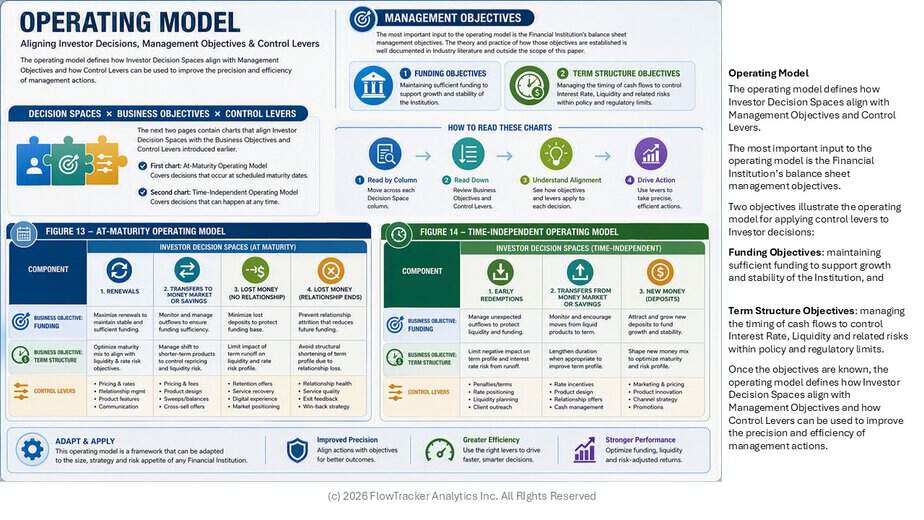
This becomes easier to see when we observe behavior rather than products. Two Customers facing the same set of offers often make different choices. One renews a CD. Another moves to Money Market. A third adds new funds. A fourth does nothing. If products alone determined outcomes, we would expect much more uniform behavior. Instead, we observe different decisions because Customers appear to value things differently. And what they value can change over time.
Notice that I am being careful here. I am not claiming to know what criteria any particular Customer used. The data cannot tell us that. What we can observe is that Customers respond differently to the same options. The existence of different choices suggests the existence of different evaluation criteria. We can observe the choice. We do not need to invent a story about the Customer’s motive.
This perspective creates an important shift in how we think about competition. Financial Institutions often assume products compete against products. CDs compete against CDs. Money Market competes against Money Market. Savings competes against Savings. That is certainly true at one level. But Customers may be conducting a different comparison. They may be comparing accessibility against commitment. Flexibility against predictability. Immediate availability against higher return. In other words, they may be comparing benefits rather than products.
Once you look at the world that way, some familiar behaviors start to make more sense. A Customer who moves money from a CD into Money Market has not necessarily rejected CDs. A Customer who renews at a lower rate has not necessarily become indifferent to pricing. In both cases, the Customer may simply be evaluating a broader set of criteria than the product manager is measuring. The product changed because the preferred combination of benefits changed.
This idea also helps explain why price is sometimes less powerful than we expect. Price matters. Clearly it matters. But if Customers are making decisions against a collection of criteria, then price is only one component of the decision process. Products also contain features, entitlements, cash flow characteristics, accessibility choices and operational conveniences. All of those can have value because Customers are optimizing their finances to suit their personal situation, not choosing product categories.
What we like most about this perspective is that it requires no new technology and almost no investment to begin exploring. Simply stop looking only at product outcomes and start looking for patterns in Customer choices. Which Customers consistently choose accessibility? Which repeatedly select longer commitments? Which regularly move between Money Market and CDs? The choices themselves provide clues about the criteria being applied. Customers are continually telling us what matters to them. Not with surveys. Not with focus groups. Through the decisions they actually make.
One of the recurring themes in this work is that Customers reveal more through their actions than through our classifications of them.
Financial Institutions see products. Customers see options.
And options are judged against criteria that belong to the Customer, not the product.