
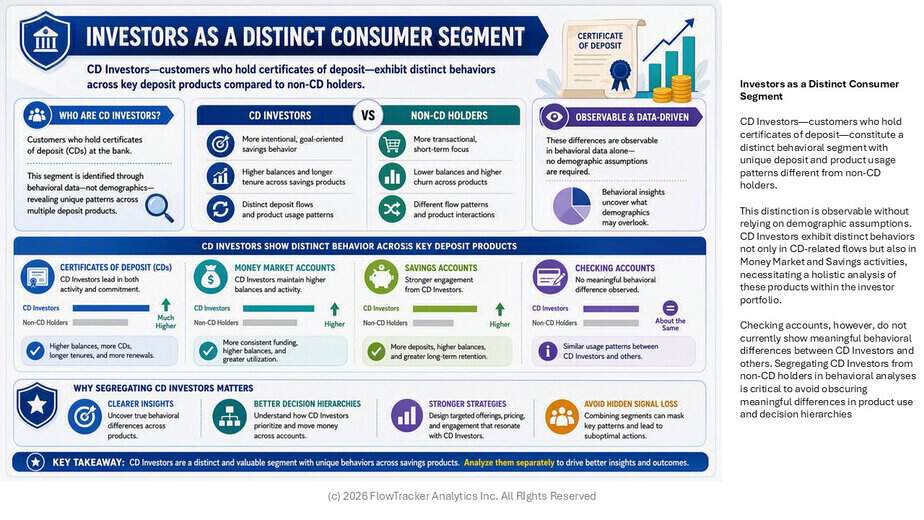
How many of your Customers own CDs? Do you look at them separately from everybody else?
Most organizations can answer the first question immediately. Far fewer answer yes to the second. That is unfortunate because we think CD Investors may be one of the most important behavioral segments in the entire deposit franchise. Not because of who they are, but because of how they use deposit products. That distinction can be significant.
The traditional way to think about deposits is through products. CDs are one product. Money Market is another. Savings is another. The organization is structured that way, the reports are structured that way, and management responsibilities are structured that way. There is nothing wrong with that operationally. The problem is that Customers are not necessarily organizing their decisions around our product hierarchy. They are making decisions about their money. The same product can play very different roles for different people and change over time.
Over many years of observing deposit behavior, we became increasingly convinced that CD Investors use the deposit franchise differently than Customers who have never owned a CD. The difference shows up not only in CD activity but also in Money Market and Savings activity. In fact, one of the most interesting observations is that once you identify the CD Investor population, Money Market starts to look different. A lot different. Same product, different behavior.
Think about what happens when a CD matures. Some money renews immediately. Some moves to a different term. Some moves into Money Market or Savings. If we stop looking at balances and start looking at money movement, we discover something interesting. A portion of that money later flows back into CDs. Viewed through a product lens these are separate events. Viewed through a behavioral lens they begin to look connected. The Money Market account appears to be participating in the Customer’s investment process rather than simply competing with the CD for balances.
That observation changed how we think about Investor Money Market balances. For many Investors, Money Market appears to function as a staging area between decisions. Money arrives there from CDs. Money leaves there for CDs. It occupies a position between commitment and accessibility.
We are deliberately avoiding any claim about why Investors do this because the data cannot tell us that. What the data can tell us is that the pattern exists, and that the pattern appears different from the behavior of Customers who have never participated in the CD portfolio.
What we like most about this idea is how easy it is to test. This is not a technology project. It is not a data science project. It is barely even a project. Create an Investor flag. Separate Customers who have ever owned a CD from those who have not. Then rerun the reports you already have. Look at Money Market balances. Look at transfers between products. Look at growth and attrition. Look at how money moves, not just where it sits. The cost is almost zero because the information already exists in most Financial Institutions.
You may discover that what appears to be a single Money Market portfolio is actually serving different functions for different populations. Familiar management questions start to look different. A movement out of Money Market may not mean the same thing for a CD Investor that it means for a non-Investor. A movement out of a CD may not be the end of an investment relationship. The interpretation changes because the behavioral context changes.
What does this mean for managing CDs? What are the implications for Liquidity? Funding?
One of the themes that runs throughout this work is that Customers frequently reveal more through their choices than through their demographics. We spend enormous effort trying to classify people, when sometimes the most useful thing we can do is observe what they have already chosen to do. CD ownership is one of those choices. It is visible. It is objective. And in our experience, it is often the first clue that there may be more than one behavioral system hiding inside what appears to be a single deposit portfolio.
Understanding Decision Spaces unlocks understanding of Consumer Depositor Behavior. Download the complete research white paper Consumer Deposits: Optimizing Decision Spaces, Explainer Infographics and the Big Ideas article series at the link above.