
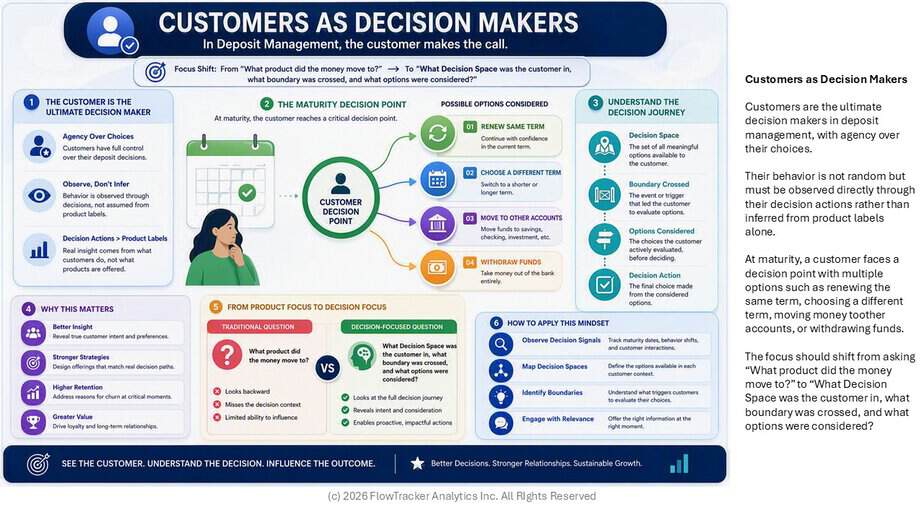
We invest a lot of energy into managing deposit products. We manage rates, terms, campaigns, channels, pricing tiers, promotions and balances. When balances rise, we celebrate a successful offer or campaign. When balances decline, we tend to blame competitor’s rates. The underlying assumption is that outcomes are controlled by the things we manage.
We think there is a problem with that perspective. It’s not all about us.
We make offers. The Customer makes the decision.
That may sound obvious, but we don’t always act as though it is true. Products, rates and campaigns certainly influence outcomes, but they do not determine them. The Customer chooses whether to accept an offer, reject it, postpone a decision, consider alternatives, or do nothing at all. Every deposit outcome we observe is the result of a Customer decision. We craft the offer. The Customer decides whether or not to accept it.
The distinction matters because it changes where we focus our attention. Consider a Customer whose CD is maturing. From the Financial Institution’s perspective, we see the account is approaching maturity and our objective is to retain the funds.
From the Customer’s perspective, something different is happening. The Customer is standing at a decision point with a variety of available options. They might renew the same term, choose a different term, move the proceeds into Money Market or Savings, add additional funds, move money elsewhere, or decide to use the money for some entirely different purpose. The maturity is not merely a product portfolio event. It is a decision event.
We can observe the decision without understanding the motive. A Customer who moves from a twelve-month CD into a six-month CD has revealed a choice. We can measure it. We can compare it with similar choices made by other Customers. We can observe how that choice changes under different conditions. What we cannot do is know with certainty why that particular Customer made that decision. Fortunately, we do not need to know. Observation is enough to begin. In fact, many management disciplines become more effective when they start with observable behavior rather than theories about motivation.
This is where we think the conventional view benefits from being turned around.
Financial Institutions manage deposits. Customers manage life.
Those are not the same thing. We are optimizing different decisions.
When we manage deposits, we naturally focus on products, balances and term preferences. When Customers manage money, they are considering options. A product view asks where the money ended up. A decision view asks which options were considered, which option was selected, and which alternatives were rejected. The two perspectives are related, but they are not interchangeable.
The difference becomes important when interpreting portfolio behavior. Suppose a CD balance leaves the portfolio. Product reporting will correctly identify an outflow. But what happened? If the money moved into the same Financial Institution’s Money Market account, the Customer crossed a product boundary without leaving the Institution. If the money moved into a different CD term, the originating product lost balances while the CD relationship remained intact. If the money left the institution altogether, that is a different event again. The accounting is correct in every case. The interpretation is not necessarily the same.
One of the most important observations in this work is that Customer behavior is not random. Customers repeatedly renew, switch, transfer, leave, return and reallocate funds. Those actions occur often enough, and consistently enough, that patterns emerge. The patterns tell us something about the choices Customers are making and the decisions they are facing. Rather than treating every movement as a product event, we can begin viewing those movements as evidence of an underlying decision system. The Customer’s decision.
That is why we believe the management opportunity begins when we turn our perspective outside-in and ask,
“What decision did the Customer make?” instead of “Where did the money move to?”
The first question looks at the process that causes change. The second question tells us what happened to the balance sheet. We like to think of it as watching the game being played, instead of reading the score the next morning.
This is the foundation of Customer Decision Space thinking. The objective is not to replace traditional product management. Product, pricing and promotion all remain important. The objective is to apply these tools more effectively to influence the decision system that Customers use to manage their money.
Bankers see products. Customers see options, and Customers decide.
Understanding Decision Spaces unlocks understanding of Consumer Depositor Behavior. Download the complete research white paper Consumer Deposits: Optimizing Decision Spaces, Explainer Infographics and the Big Ideas article series at the link above.